
It’s no surprise headlines are talking about a nursing shortage. The Health Resources and Services Administration (HRSA) (opens a new window) projects the U.S. will have 8% fewer registered nurses (RNs) than it needs in 2028. That’s a gap of roughly 267,000 full-time equivalent RNs. But is this really a shortage, or is it a demand issue that few organizations are prepared to handle? Getting ahead of it starts with a shift in mindset, from seeing this as a national problem outside your control to proactively attracting and retaining nurses through a more effective total rewards strategy.
Are there actually fewer nurses?
The nursing workforce isn’t shrinking. Nursing is the largest profession in healthcare, according to the American Association of Colleges of Nursing (AACN) (opens a new window), and the Bureau of Labor Statistics (BLS) (opens a new window) counts about 3.38 million employed RNs in 2025, up from about 2.99 million in 2020. BLS projects RN employment will grow by about 195,000 jobs from 2025 to 2035, faster than the average for all occupations. But it also expects about 181,000 openings every year, many from replacing nurses who retire, leave the workforce, or switch occupations.
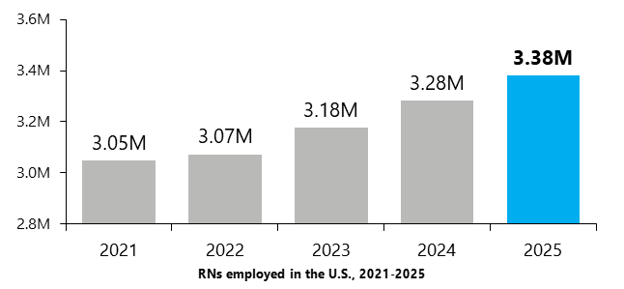
Registered nurses employed in wage and salary jobs in the U.S., May of each year. Source: U.S. Bureau of Labor Statistics, Occupational Employment and Wage Statistics (OEWS). Counts exclude self-employed nurses.
Note: Year-to-year changes may be affected by changes in BLS estimation methods.
Enrollment in bachelor’s degree nursing programs is also up: entry-level programs added nearly 20,000 students, according to the latest AACN survey (opens a new window), bringing total enrollment to 283,303. HRSA’s projected gap is the difference between the nurses needed and the nurses available, and it assumes historical rates of nurses leaving the workforce, graduating, and participating in the labor force hold steady. Employers can’t control the national numbers, but they can control how many nurses they keep in their organization.
Early-career and younger nurses are among the most likely to leave: nearly 23% of new RN hires leave within a year, and Gen Z and millennial RNs turn over at 22% and 21%, compared with 14% for Gen X, according to the Nursing Solutions, Inc. (NSI) 2026 National Health Care Retention & RN Staffing Report (opens a new window). Recruiting mid-career nurses is difficult. Many healthcare organizations set pay ranges near the market median, which makes it hard to draw talent away from competitors on pay alone. The key to a stable workforce is retaining early-career nurses as they grow into experienced providers and leaders.
Why nurses leave
Day-to-day working conditions are a big part of why healthcare organizations may have a retention problem. As hospitals run leaner, nurses are carrying heavier, less predictable workloads and caring for sicker, more complex patients. Violence only adds to the strain. Press Ganey data (opens a new window) shows assaults on nursing personnel began rising in 2022 and peaked in 2023 and 2024. They have eased slightly since but remain above prepandemic levels. Nurses also absorb the frustration of patients and families dealing with delays and gaps in care.
Not seeing a clear path to move up, build new skills, or change roles compounds the problem. NSI (opens a new window) lists career advancement among the top reasons nurses leave. Over time, those pressures add up, and staying in the job gets harder to justify.
The cost of turnover
After a decline in 2024, RN turnover is climbing: 17.6% of hospital RNs left their jobs in 2025, according to the NSI Report (opens a new window), up from 16.4% the year before. Replacing a single staff RN costs an average of $60,090, which adds up to an estimated $5.19 million in annual costs for the average hospital. Each percentage-point change in RN turnover is worth approximately $295,000 a year.
What employers can influence
The national headlines can make it feel like there’s nothing an organization can do. But every employer competes for talent, and the ones that do it well feel far less staffing pressure than the ones that don’t. Some of what drives nurse turnover is outside any organization’s control. But career development, time off, workplace culture, and the wellbeing support nurses receive are all things an employer can shape. Employers should be intentional about attracting the best nurses and keeping the ones they have.
Pay is usually the first lever many employers pull, and higher salaries, sign-on bonuses, premium pay, overtime, and contract labor can help cover immediate staffing needs. But pay alone offers limited differentiation: salaries are often close to market benchmarks, and annual increases can feel less meaningful against rising living costs. Still, reducing turnover isn’t about finding a single benefit or program that convinces nurses to stay. It takes a complete total rewards strategy that connects what an organization offers to what its nurses need and value, and those needs look different depending on career stage, specialty, location, and personal circumstances. That means looking at the entire employee experience, from benefits and wellbeing to career growth and support throughout a nurse’s career.
Employers are managing real cost and workforce pressure, and at the same time nurses have real expectations about what makes a job worth staying in. In Lockton’s September 2026 Healthcare Market Update (opens a new window), hospitals and health systems reported cost reduction overtaking talent as a priority, though by a smaller margin than the broader market. Work/life balance matters especially for nurses, many of whom are caregivers at home as well as at work. Meaningful paid time off and scheduling flexibility give them room to manage both roles, which can make the difference in whether they stay in the profession. The organizations that treat nurses as a critical workforce and build rewards around what they value can address both.
Turning workforce pressure into an opportunity
The encouraging part is that turnover is rarely a surprise. Disengagement, less feedback, and declining trust often show up months before a resignation, which means it’s more predictable than it looks. Employers that want to compete for nurses can start with a few questions:
Are employees finding value in the total rewards available to them?
Are career growth and development opportunities clear?
Does the employee experience support people at different stages of their careers?
Are front-line leaders supporting employees in using their rewards, such as making time for career development opportunities that lead to higher pay?
Do employees know about their rewards and understand their value, or are communication gaps keeping the right investments from having their intended effect?
Nursing workforce challenges will keep making headlines. Employers can treat them as a national problem outside their control, or they can recognize nurses as a critical workforce and compete for them intentionally.
Lockton’s healthcare experts work with hospitals and health systems to understand what’s driving turnover in their workforce, evaluate whether current total rewards investments deliver value for employees, and build a strategy that balances cost and talent. We help you connect benefits, compensation, time off, and career development with clear communication and leadership support, so every dollar works harder for your people. Contact your Lockton representative to start the conversation.