Skip to main content


ALERT / JUNE 17, 2026
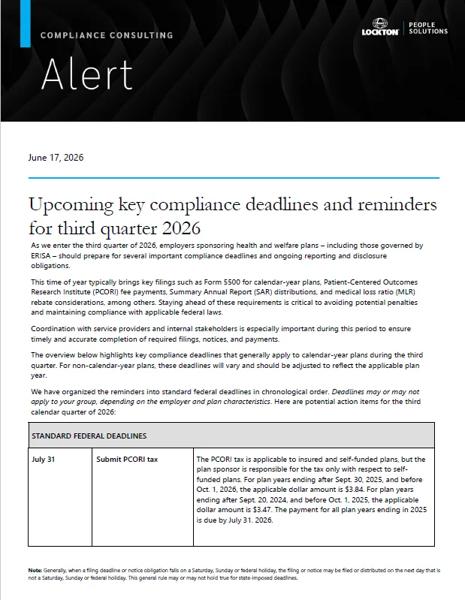
Upcoming key compliance deadlines and reminders for third quarter 2026
8 MIN READ
As we enter the third quarter of 2026, employers sponsoring health and welfare plans – including those governed by ERISA – should prepare for several important compliance deadlines and ongoing reporting and disclosure obligations.
This time of year typically brings key filings such as Form 5500 for calendar-year plans, Patient-Centered Outcomes Research Institute (PCORI) fee payments, Summary Annual Report (SAR) distributions, and medical loss ratio (MLR) rebate considerations, among others. Staying ahead of these requirements is critical to avoiding potential penalties and maintaining compliance with applicable federal laws.
Coordination with service providers and internal stakeholders is especially important during this period to ensure timely and accurate completion of required filings, notices, and payments.
The overview below highlights key compliance deadlines that generally apply to calendar-year plans during the third quarter. For non-calendar-year plans, these deadlines will vary and should be adjusted to reflect the applicable plan year.
We have organized the reminders into standard federal deadlines and select state and local deadlines in chronological order. Deadlines may or may not apply to your group, depending on the employer and plan characteristics. Here are potential action items for the third calendar quarter of 2026:
STANDARD FEDERAL DEADLINES
July 31 - Submit PCORI tax
The PCORI tax is applicable to insured and self-funded plans, but the plan sponsor is responsible for the tax only with respect to self-funded plans. For plan years ending after Sept. 30, 2025, and before Oct. 1, 2026, the applicable dollar amount is $3.84. For plan years ending after Sept. 20, 2024, and before Oct. 1, 2025, the applicable dollar amount is $3.47. The payment for all plan years ending in 2025 is due by July 31. 2026.
The fee does not apply to most “excepted benefits” or to health reimbursement arrangements (HRAs) where the HRA and associated medical plan are self-insured and have the same plan year.
The PCORI tax may NOT be paid with ERISA plan assets in most cases (there is an exception for certain multiemployer plans); it is the responsibility of the employer or plan sponsor. The tax is submitted with and reported on IRS Form 720 (opens a new window) for the second calendar quarter, under Part II of that Form.
July 31 - File Form 5500 for the plan year ending Dec. 31, 2025 (Unless extension is obtained)
ERISA plans with a calendar-year plan generally must file Form 5500 by July 31 annually unless the plan sponsor obtains an extension.
This applies to all calendar-year ERISA plans unless otherwise exempted. Filing is completed electronically through the Department of Labor’s (DOL) EFAST2 portal. More information on how to file electronically can be found here. (opens a new window)
Welfare plans (other than MEWAs) that are fully insured, unfunded, or a combination of both are excused from filing if they have fewer than 100 participants covered on the first day of the ERISA plan year.
Form 5500 extensions are available by filing Form 5558 with the DOL on or before the filing’s initial due date. Filing Form 5558 can allow the plan up to an additional 2 1/2 months to complete the filing.
Sept. 30 (or Dec. 15 if Form 5500 is filed under an extension) - Distribute Summary Annual Report (SAR) (For calendar-year plans)
A summary of the plan’s financial performance for the previous calendar year must be distributed to participating employees, former employees, COBRA beneficiaries and Qualified Medical Child Support Order (QMCSO) recipients within nine months of the close of that plan year.
The SAR requirement does not apply to self-funded plans that pay benefits exclusively from the employer’s general assets, even if those do include employee contributions, as long as those contributions are made through a Section 125 cafeteria plan.
SAR language is rather standard, and the disclosures may be made according to the DOL’s requirements for electronic disclosure if desired.
Sept. 30 - Pay annual fee due from health insurers
Self-funded MEWAs must make fee payments by Sept. 30 via electronic transfer. MEWAs with $25 million or less in net written premium for a “data year” will not owe any annual fee for the “fee year” that follows (Self-funded MEWAs are rare).
Sept. 30 - Medical Loss Ratio (MLR) rebates
Issuers must spend a minimum percentage of their premium dollars, or medical loss ratio (MLR), on medical care and healthcare quality improvement. Issuers that do not meet the applicable MLR must pay rebates to consumers.
Sponsors of insured health plans may receive rebates if their issuers do not meet their MLR. Rebates must be provided to plan sponsors by Sept. 30, following the end of the MLR reporting year. Employers that receive rebates should consider their legal options for using the rebate. Any rebate amount that qualifies as a plan asset under ERISA must be used to benefit the plan’s participants and beneficiaries.
Also, as a general rule, plan sponsors should use the rebate within three months of receiving it to avoid ERISA’s trust requirements. Plan sponsors that receive a rebate before Sept. 30 may need to adjust their deadline to use the rebate.
Aug. 31 and Sept 30 - File Form 5500 for plan years ending Jan. 31, 2026, and Feb. 28, 2026, respectively
ERISA plans must file a Form 5500 at least annually unless the plan is exempted from the filing requirement. Filing is accomplished electronically through the DOL’s EFAST2 (opens a new window) portal.
Form 5500 extensions are available by filing Form 5558 with the DOL on or before the filing’s initial due date. Filing Form 5558 allows the plan up to an additional 2 1/2 months to complete the filing.
SELECT STATE AND LOCAL DEADLINES
July 1 - Managed Care Organization Payor Assessment (Pay monthly assessment fee for services rendered in Massachusetts)
The Massachusetts Managed Care Organization (MCO) Payor Assessment applies to managed care organizations, including carriers and self-funded plans with Massachusetts members.
July 1 - New Mexico Vaccine Purchase Act (VPA) (Submit covered lives assessment annual reporting)
The New Mexico Vaccine Purchasing Act (VPA) applies to fully insured plans and self-insured ERISA plans (including TPAs) covering children under age 19 who reside in New Mexico.
July 1 - New Mexico Vaccine Purchase Act (VPA) (Submit covered lives assessment payment for previous quarter)
The New Mexico Vaccine Purchasing Act (VPA) applies to fully insured plans and self-insured ERISA plans (including TPAs) covering children under age 19 who reside in New Mexico.
July 25 - Vermont Health Care Fund Contribution Assessment (HCFCA) (Submit assessment payment for previous quarter)
The HCFCA is a quarterly employer assessment designed to support Vermont’s healthcare programs. Employers with five or more full-time equivalent (FTE) employees in Vermont who do not offer health coverage to all employees may owe this assessment.
July 30 - San Francisco Health Care Security Ordinance (HCSO) (Make San Francisco HCSO contributions for the prior calendar quarter)
Applies to all employers subject to the San Francisco Healthcare Security Ordinance.
July 30 - Rhode Island Vaccine Assessment Program (RIVAP) (Submit reporting and assessment payment for previous quarter)
The Rhode Island Vaccine Assessment Program (RIVAP) requires certain health plans and payers to fund the state’s universal vaccine purchasing program through quarterly assessments based on covered lives.
July 31 - Washington Cares (Submit reporting and remit payroll tax withholdings for previous quarter)
Applies to fully insured and self-insured ERISA plans. Employers collect premiums from employees via after-tax payroll withholdings to support WA Cares long-term care insurance program.
Aug. 3 - Managed Care Organization Payor Assessment (Pay monthly assessment fee for services rendered in Massachusetts)
The Massachusetts Managed Care Organization (MCO) Payor Assessment applies to managed care organizations, including carriers and self-funded plans with Massachusetts members.
Aug. 15 - Alaska Vaccine Assessment Program (Submit quarterly covered lives reporting and assessment)
Employers and other assessable entities (health insurers, TPAs, self-funded ERISA plans) must report covered lives and vaccine usage data to the Alaska Vaccine Assessment Program (AVAP).
Aug. 15 - Maine Vaccine Board (Submit quarterly covered lives reporting and payment for previous quarter)
Employers and health plans subject to Maine’s Vaccine Board childhood immunization assessment (health insurers, TPAs, self-funded employers) must report covered lives quarterly.
Aug. 15 - New Hampshire Vaccine Association (Submit reporting and payment for previous quarter)
Health insurers, TPAs, and other assessable entities must report covered lives under age 19 and pay quarterly assessments.
Aug. 15 - New Hampshire Health Plan (NHHP) (Submit covered lives reporting and assessment for previous quarter)
The New Hampshire Health Plan (NHHP) Assessment funds key state health initiatives. Health carriers, TPAs, and other assessable entities must report covered lives and pay quarterly assessments.
Aug. 15 - WAPAL Fund (Submit covered lives reporting and assessment for previous quarter)
Applies to all assessed entities with covered lives in Washington, including Washington employers and out-of-state employers with covered lives in Washington. Applies to fully insured and self-insured ERISA plans.
Aug. 15 - Vermont Vaccine Purchasing Program (VVPP) (Submit reporting and assessment payment for previous quarter)
The Vermont Vaccine Purchasing Program (VVPP) is Vermont’s universal vaccine program. It applies to health insurers, self-insured employers, TPAs, HMOs, and other entities that cover Vermont lives.
Sept. 1 - Managed Care Organization Payor Assessment (Pay monthly assessment fee for services rendered in Massachusetts)
The Massachusetts Managed Care Organization (MCO) Payor Assessment applies to managed care organizations, including carriers and self-funded plans with Massachusetts members.
Sept. 1 - Connecticut Vaccine Program (Submit annual reporting)
The Connecticut Vaccine Program (CVP) is a universal vaccine purchasing program that applies to insurers, HMOs, TPAs and certain self-funded plans covering Connecticut residents and requires annual reporting of covered lives to support program funding and vaccine distribution.
For more alerts, insights and additional information, click here (opens a new window) to visit Lockton's ERISA Compliance Consulting page.
 Download alert (opens a new window)
by Petra Wheaton
Assistant Vice President, Employee Benefits Compliance Analyst